
Frequently Asked Questions
General FAQ
Your Title Goes Here
Your content goes here. Edit or remove this text inline or in the module Content settings. You can also style every aspect of this content in the module Design settings and even apply custom CSS to this text in the module Advanced settings.
What is JPL Workers United (JWU-UAW)?
We are a group of Jet Propulsion Laboratory workers who are forming a union in order to improve our working conditions and thereby our work. As JPL workers, we take pride in our contributions to the world-renowned science and engineering that comes from JPL. This requires a diverse workforce of scientists, engineers, deep space network team, business administrators, facilities and logistics coordinators, contract and acquisition teams, information technologists, mission safety officers, and many more. Recently, we have recognized the need for a stronger voice in workplace decisions to ensure we can continue doing the work we love. In response, many JPL workers are seeking to form a union, which we call JPL Workers United (JWU-UAW), and collectively bargain over our conditions of employment, following the example of millions of other workers across the country.
You can view the issues page of our website to learn more about some of the working conditions we want to improve by having an equal say in the workplace.
How did my union, JWU-UAW, get started?
JPL Workers United held its first formal General Meeting with three JPLers in attendance. There were many motivations for starting the process of organizing a union at JPL; issues discussed in the first meetings included a lack of transparency to salary structures and pay equity (this was before California SB1162 required that employers share this information), a newly imposed salary “tier” system for remote employees, and broader unilateral changes to the telework policy. The focus of discussions quickly shifted away from stand-alone issues to the strategies and tactics of organizing, following a recognition that it was only through collective action that we would have power to confront and change the issues we faced.
The organizing committee grew, becoming stronger with the combined problem-solving capabilities that JPLers are known for. We sought expertise first from CWA, and eventually voted in spring 2024 to affiliate with UAW, who provide knowledge from successful campaigns at academic institutions and worked with Caltech Grads and Postdocs to form a union on campus. Over the past several years, there have been a series of crises and issues that have affected essentially every worker at JPL, making the necessity and urgency of unionization even more clear. The story of JWU-UAW’s formation is not yet complete—we are the union, and it will take all of us to author this story together.
Who is part of JPL Workers United?
JPL Workers United seeks to represent regular full-time and part-time JPL employees who receive their paychecks from Caltech. If you are a JPL employee and have questions or want to sign up, please contact: info@jplworkersunited.org or reach out to us on the “contact us” part of the website.
What about international workers?
Under federal law, international workers have the same rights and protections as US citizens to form and join unions. Tens of thousands of international workers are already unionized and participate fully (including holding leadership positions) in unions such as Caltech Grad Researchers and Postdocs United (UAW Local 2478), the fellows at the National Institutes of Health (NIH Fellows United), the University of California’s Union of Postdocs and Academic Researchers (UAW Local 4811) and the Columbia Postdoctoral Workers (UAW Local 4100).
Many foreign nationals are involved in forming JWU-UAW because they want to win protections that are especially valuable for international employees, such as protections from unfair termination, discrimination, visa-related issues, and more.
Are there other Caltech, FFRDC, or NASA unions?
Yes! In fact, we partnered with UAW because Caltech’s grad researchers and postdocs, who recently won their first union contract, also formed a union with support from UAW. UAW is the largest union for researchers and academic workers with over 125,000 members at more than 3 dozen institutions like the UC system, University of Washington, NIH, Caltech, and more. Of course, JPL’s work is broader than just research, but we hope to build on the success of these other campaigns and continue to change science for the better. Many civil servants are also unionized (including 53% of NASA employees), and while we are not civil servants, there are also unions at other FFRDCs, including the Aerospace Corporation and Lawrence Berkeley National Laboratory, who have successfully bargained for strong union contracts.
What is a union?
Your Title Goes Here
Your content goes here. Edit or remove this text inline or in the module Content settings. You can also style every aspect of this content in the module Design settings and even apply custom CSS to this text in the module Advanced settings.
What is a union? What does it mean for JPL workers to unionize?
A union is an organized group of workers who have a say in their working conditions and terms of employment. This is done through collective bargaining, which is the only way in which we as JPL workers can have the power to negotiate with management as equals.
With collective bargaining, we set our priorities and our agenda, and we elect fellow peers as representatives to negotiate for improvements to our working conditions on our behalf. Ultimately, any tentative agreement that is reached must be ratified by a democratic vote of all members of JWU-UAW.
Without a union, JPL retains unilateral power to change conditions, for better or worse. Forming a union not only gives us a say in our day-to-day working lives, but also strengthens our voice in an increasingly difficult external environment. And, as a part of a nationwide movement to unionize, we are collectively improving conditions across the board, not just here at JPL.
What is collective bargaining?
Collective bargaining is a process, governed and protected by law, in which employees are able to meet with their employers on equal ground to negotiate terms of employment. This can include pay, benefits, work hours, leave, health and safety policies, ways to balance work and family, and more. In the process of collective bargaining, JPLers represented by JWU-UAW will elect peer representatives to negotiate with management to put the terms of our employment into a legally-binding agreement that we vote to ratify before it goes into effect. Once a contract is ratified, the employer cannot make any unilateral alterations. It is easy for an employer to ignore an individual employee’s concerns, but when employees come together to form a union, we have the strength to make ourselves heard. Through collective bargaining, millions of working people in unions have higher wages, better benefits, and safer workplaces.
How does a union form?
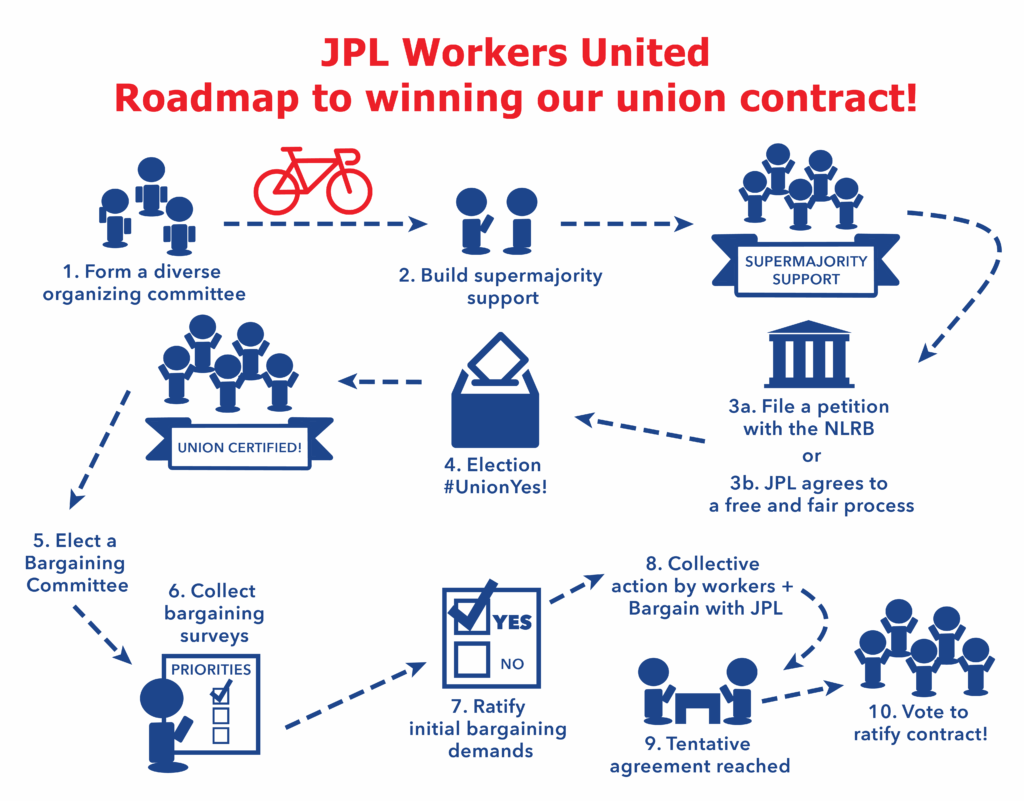
This is a roadmap of how a union is formed (also refer to Logistics FAQ below for additional detail):
Will recent changes at the federal level, particularly at the NLRB, impact JWU?
Despite attempts to weaken workers’ protections through attacks on the NLRB at the national level, union elections have continued to take place. As recently as June 11th, the Johns Hopkins postdocs union was certified with 97% voting ‘YES’. So far in 2025, over 12,351 research / higher education workers have formed unions with UAW.
What is UAW?
Your Title Goes Here
Your content goes here. Edit or remove this text inline or in the module Content settings. You can also style every aspect of this content in the module Design settings and even apply custom CSS to this text in the module Advanced settings.
What is UAW?
UAW is the United Automotive, Aerospace, and Agricultural Implement Workers of America and is one of the largest unions for research and higher-ed employees in the country, with over 125,000 members at research institutions and growing. Caltech graduate students and postdoc workers; University of California and Lawrence Berkeley National Laboratory student researchers, postdocs, and academic researchers; University of Southern California graduate students; and National Institute of Health fellows are all part of UAW.
In addition to drawing on the UAW’s success with bargaining contracts, we can exercise a stronger political voice through the UAW. With active members at more than 45 major campuses across the US, the UAW has become a strong advocate on policy issues that matter to us as research-funded workers, such as federal support for science funding and enhancing the rights of international research scientists.
How are JWU and the UAW collaborating?
We, the JPL employees, are the union and a part of the UAW. JPL workers will democratically decide on strategy and tactics for forming our union, elect our own bargaining team, vote on our contract, vote to authorize a strike if necessary, and other actions. All UAW locals contribute a portion of our dues to the international union to assist in organizing new groups of workers, the strike fund, and political action across the country. No one will be expected to pay any dues or fees until we have democratically approved a contract. Dues from other UAW members are currently supporting our organizing campaign at JPL.
Doesn’t UAW have a track record of being corrupt?
In 2018, news broke about a scheme by a group of UAW officials to misuse union funds. The allegations, which were brought forward by a UAW member, lead to 14 UAW officials being charged with corruption and pleading guilty in federal court. All of those found to have committed wrongdoing were stripped of their UAW membership and all funds lost as a result of their actions were recovered.
Although that news was startling and gave rise to a number of worker-led reforms, tens of thousands of workers continued to organize with UAW because of its proven track record of supporting worker-led, democratic collective bargaining. In 2024, JPLers reached out to UAW in part because significant reforms produced a highly dynamic, progressive institution that embraces rank and file member participation. Some specific steps that UAW members have taken to reform include:
- UAW members voted in favor of a referendum to move to a “one member, one vote” system for electing high-ranking UAW officials. This provides all UAW members with a direct say in who is leading UAW at every level.
- UAW voted to create Region 6 to ensure more local control and autonomy for unions on the West Coast.
- UAW agreed to federal oversight to root out any additional corrupt officials, to implement further reforms to safeguard against future corruption, and strengthen member participation and democracy.
- UAW established a third-party, confidential ethics hotline and hired outside experts to analyze and improve accounting and financial controls.
Additionally, local unions, such as JWU-UAW, have their own elected leadership and are obliged to adhere to strict financial controls, including a twice yearly audit of all expenses.
Union Benefits
Your Title Goes Here
Your content goes here. Edit or remove this text inline or in the module Content settings. You can also style every aspect of this content in the module Design settings and even apply custom CSS to this text in the module Advanced settings.
What issues can a unionized JPL workforce fight for?
JPLers will have multiple opportunities to complete bargaining surveys on the issues that we would like to improve or protections that we would like to establish through the bargaining of our first contract. Then, JPLers will draft initial bargaining demands based on feedback from the bargaining survey and vote to ratify those. Many of the issues that have come up frequently in our conversations with co-workers can be addressed through collective bargaining, and there are many examples we can look to from the contracts of other unions.
Common improvements include but are not limited to:
- Increased transparency and fairness in pay setting and raises
- New or improved benefits, and prevention of existing benefits being unilaterally rescinded
- Protections from discrimination and harassment in the workplace
- A process for the resolution of disputes with management by a neutral, third-party arbitrator
- Enhanced workplace safety and accessibility
- Having a say in the lay off process
What JPL workers can win in a contract isn’t limited by this list. We get to choose what’s important to us here at JPL throughout the collective bargaining process.
Some of these issues are further highlighted and expanded upon in the issues section of the website.
How could a union improve protections against discrimination and harassment?
Many contracts include language that explicitly prohibits harassment and discrimination based on common workplace abuses, including discrimination based on race, gender, sexuality, and disability. A union contract can also include language that compels JPL to address problems in a timely manner and provide greater accountability. For example, at Caltech, the graduate student workers and postdocs won protections against harassment and discrimination that include clear timelines, interim measures, and a process for a neutral, third-party arbitrator to make the final decision on disputes. Coworkers can also take collective action to support one another and ensure complaints are satisfactorily addressed.
How have international workers benefited by having a union in the workplace?
UAW has become a powerful organization in advocating to improve conditions for international workers. For years, UAW members have fought hard to ensure that the contributions of international workers are elevated and that the terms and conditions of their employment are improved.
The UAW helped lead the fight against Executive Orders issued during the first Trump presidency that targeted international scholars and students. In October of 2020, UAW Academic Workers mobilized against a proposed rule by ICE to shorten visa stays for international scholars; thousands of public comments were submitted, including by the President of the UAW International. In July of 2020, thanks to direct action by UAW Academic Workers across the country, in addition to efforts by allies at universities and in government, ICE backed down from its directive to deport international students taking online classes due to COVID-19. In 2017, the UAW International filed an amicus brief in the Supreme Court case challenging the Trump administration’s travel ban. The UAW also helped lead the fight to enhance the Optional Practical Training (OPT) program as an important path for international student workers to work in the US after completion of their PhD.
UAW academic unions also provide more resources for researchers on visas at the local level. University of California postdocs have used their union to fight for international researchers who could not return to the US during the COVID-19 pandemic to be able to work remotely.
Additionally, in early 2025 the UAW established a national hotline for members facing immigration-related issues. The hotline connects members with legal professionals who can provide guidance and referrals to legal counsel for immigration-related matters, including emergencies.
Logistics
Your Title Goes Here
Your content goes here. Edit or remove this text inline or in the module Content settings. You can also style every aspect of this content in the module Design settings and even apply custom CSS to this text in the module Advanced settings.
What does it mean to sign a union authorization card?
Signing a card means that you support forming a union and agree to be represented by the union – that is, JPL workers deciding for ourselves democratically what we want to bargain for and electing peer representatives – in collective bargaining. We encourage all JPLers to make an informed decision about unionization.
How does union recognition work?
There are several pathways for union recognition. The most common route is to deliver our signed cards to the National Labor Relations Board (NLRB). The NLRB requires at least 30% of eligible employees to sign cards to trigger an election; however, we want to file our petition or demand recognition with supermajority support. The more support we show, the more power we have to win a strong contract. The NLRB requires a majority of votes cast in the election to be supportive. Alternatively, we could work with JPL/Caltech to have a free and fair recognition process. For example, Contract Faculty United-UAW (the union for non-tenure-track faculty at NYU) reached an agreement with the NYU administration for their union election: NYU agreed to remain neutral and the American Arbitration Association independently administered the election. Whether we have a NLRB election or JPL/Caltech agrees to a fair and free recognition process, we will want to have as much turnout and support as possible to create a mandate for negotiating a strong contract.
Could the union be voluntarily recognized by JPL/Caltech?
Yes. Once a majority of our community has signed authorization cards, management could voluntarily recognize JWU-UAW. In this case, management would work with us to develop an agreement in which, for example, a neutral third party would count our confidential cards to verify sufficient support for a vote, and hold a vote that’s administered through a different entity than the NLRB. Whatever the process, it’s critical as a first step that a supermajority of us sign authorization cards choosing to be represented and supporting the formation of the union so that it is clear that we have made this choice.
Is signing a union authorization card confidential?
Yes, a signed union authorization card will remain confidential between the signer and your peers who will be collecting the card from coworkers. Workers have the right to keep their support for a union confidential, ensuring their decision isn’t influenced by potential pressure or fear of retaliation. Furthermore, JPL management will have no knowledge or access to information on JPL employees who sign union cards. While every worker has the choice to keep the status of signing a union authorization card confidential, we strongly encourage everyone to be publicly supportive of forming a union in the workplace.
How would the collective bargaining process work at JPL?
After we win certification or recognition of our union, workers will fill out bargaining surveys to articulate priorities for a contract. We will also elect representatives, fellow coworkers, to a bargaining committee. Guided by the feedback in the bargaining surveys, the elected committee develops initial bargaining demands that we vote to approve. The elected bargaining committee will then work on drafting a contract proposal to bring to the bargaining table. Once bargaining begins, management and JWU-UAW will meet many times to discuss our proposals and negotiate over language that both sides can agree to. Once a tentative agreement is reached, workers must vote to accept or reject the contract before it goes into effect.
Thousands of graduate student workers and postdocs at Caltech (UAW 2478) recently bargained with the administration and won a union contract.
How long will it take to bargain our first contract with JPL?
The length of time necessary to negotiate a first contract depends on the strength of worker support and determination and the willingness of the employer to bargain in good faith. JPL could ensure a timely process by agreeing on a fair and efficient timeframe with regularly scheduled bargaining sessions and a strong commitment to reaching a fair agreement.
Earlier this year, Caltech graduate and postdoc workers negotiated their first contract in 12 months. Postdocs at Columbia University, University of Connecticut, University of Washington, and University of California negotiated for 16 months, 13 months, 13 months, and 18 months respectively, while graduate students at USC negotiated their first contract in 8 months. However, with a serious commitment to reach a fair agreement by the administration, 4,000 student employees at the University of Washington negotiated their first contract in just under two months!
Each bargaining timeline is unique to the workplace and JWU-UAW’s timeline will be decided by the power we are able to build together through the campaign.
Will I have to pay union dues?
Membership dues are important because they provide the resources necessary for effective representation. JPL workers will not pay any dues until we have gone through the bargaining process and voted democratically to approve our first contract. Once ratified, JPLers can sign up as dues-paying members. Dues are a critical component of providing JWU with independent resources that are not controlled by JPL. The funds will be used to ensure we have appropriate legal, bargaining, community, and staff support to represent JPLers during future negotiations.
Most contracts include a non-union-member “fair share” fee, so that the cost of representation is shared equally and we have more resources available to enforce our rights and campaign for future contracts. JPL workers would decide if we want to seek a similar provision as part of our bargaining agenda.
UAW membership dues are currently 1.44% of gross monthly income and can only be increased by membership action. There is also a one-time initiation fee, which ranges from $10 to $50 and is determined democratically in local union bylaws approved by members.
Additional benefits won through bargaining usually offset the dues paid to the union – for example, postdocs at Columbia University went from having the lowest minimum salaries for postdocs in NYC to the highest in the first year of their contract, an increase of between 14.5% to 20%, along with guaranteed annual increases and other improvements. UC graduate researchers won raises ranging from 25–80% in their first contract.
Does everyone have to be part of the union?
No one will be asked to sign up as a member of JWU-UAW until after we vote to ratify our contract and see the benefits that we negotiate and win.
If someone chooses not to become a union member, then they would not have the ability to vote on union decisions and future actions. Everyone in our bargaining unit – covered by the collective bargaining contract and eligible to be a union member – receives all the benefits of the final contract. However, we will have the most power by having high union membership.
We hope everyone will recognize the benefits that come when we all stand up together and realize that we want to hear everyone’s voice!
Does forming a union mean we will go on strike?
While striking is a powerful tool for workers to achieve our objectives, we would decide democratically whether or not to call a strike. Under the UAW constitution, a strike can only occur after a vote in which 2/3 of members voting authorize their elected representatives to call a strike.
Thousands of academic workers have democratically decided to go on strike in the past few years to win their demands. This was illustrated perfectly in December and January by the Caltech Grad Researchers and Postdocs Union. Dissatisfied with Caltech’s failure to bargain in good faith, they voted to authorize a strike in early December. This motivated management to get down to business and resulted in a tentative agreement on January 20th, without having to actually initiate the authorized strike.
If JPL workers vote to authorize a strike and then actually call the strike, JPLers could decide whether to actively participate and we could take sufficient time to prepare critical assets to maintain a safe state until work could be resumed.
Other Questions about Unionizing at JPL
Your Title Goes Here
Your content goes here. Edit or remove this text inline or in the module Content settings. You can also style every aspect of this content in the module Design settings and even apply custom CSS to this text in the module Advanced settings.
Is it legal for an employer to retaliate?
No! Know your rights – the National Labor Relations Act (NLRA) is hard-won federal legislation which protects unionization in the workplace and other collective employee actions.
It is unlawful for an employer to interfere with, restrain, or coerce employees in the exercise of their rights (including terminating union organizers or supporters without cause). We have a large number of people already publicly supporting JWU-UAW, and the more people who are involved, the safer it becomes.
What can we expect from JPL/Caltech?
Caltech opposed graduate students and postdocs unionizing and we should prepare for the fact that JPL might do so as well. Management in any organization usually opposes a union because they want to make all of the decisions about our workplace; once we have a union, we’ll have a say over what our workplace looks like.
Will forming a union impact funding for JPL or the prime contract?
We acknowledge that this is an uncertain time, including for JPL, however over half of NASA’s workforce, as well as workers at other FFRDCs, belong to a union, and workforces at other NASA centers have been actively fighting back against cuts proposed by the Trump administration. Workers are still organizing, with more than 12,351 research / higher education workers forming unions with UAW just in 2025, and unions can push back on unlawful cuts – UAW was a plaintiff in one of the lawsuits that successfully restored funding to hundreds of National Institute of Health grants. JPL workers are joining a larger movement of federally-funded researchers and institutions standing up against cuts to science funding.
While we can’t foresee all our future challenges, we have more power and protections and a say in how we respond to these obstacles if we join together with our fellow JPL workers as well as alongside workers across NASA and other similar institutions.
Will forming a union limit JPLers direct relationship with supervisors?
No. As a union, JPL employees will be negotiating with JPL/Caltech, not with our direct supervisors, because it is the Lab’s policies that define our employment conditions. Moreover, JPLers will set the bargaining agenda and decide what improvements to prioritize in collective bargaining.
Other UAW researcher and professional staff contracts have established minimum rights on different aspects of working conditions, while preserving the ability of individuals and supervisors to agree on terms. For example, at Lawrence Berkeley National Lab, which is another FFRDC where workers formed a union and won a contract, project scientists negotiated reasonable work hours and schedules (see their contract here) but stipulated the need for unit members to be flexible with those hours.
Is JWU-UAW anti-management?
No. Through our union, we hope to negotiate with JPL to improve our lives so we can continue doing the work we love. We are fighting for ourselves and for our coworkers. We believe that we have common ground to improve our working conditions, that we can stand up together for one another with dignity, and that we are stronger united.
FOLLOW UP
Your Title Goes Here
Your content goes here. Edit or remove this text inline or in the module Content settings. You can also style every aspect of this content in the module Design settings and even apply custom CSS to this text in the module Advanced settings.
I’m interested in joining – what can I do?
Great! First, make sure you sign the unionization card.
If you would like to join the organizers to help disseminate the information about JPL Workers United to other coworkers, please get involved!
Thank you for joining with your coworkers to push for a better JPL!
I have another question that isn’t answered here.
Please reach out to us at info@jplworkersunited.org or reach out to us on the “contact us” part of the website.