
From JPL’s Website: United Auto Workers
What They Wrote | Our Response |
At its peak, UAW had over 700,000 members. Fast forward to today and the UAW has lost nearly half of its membership and now has fewer than 400,000 members. | Union membership has greatly declined in the United States over the last few decades. As unions have declined, so has income equality. 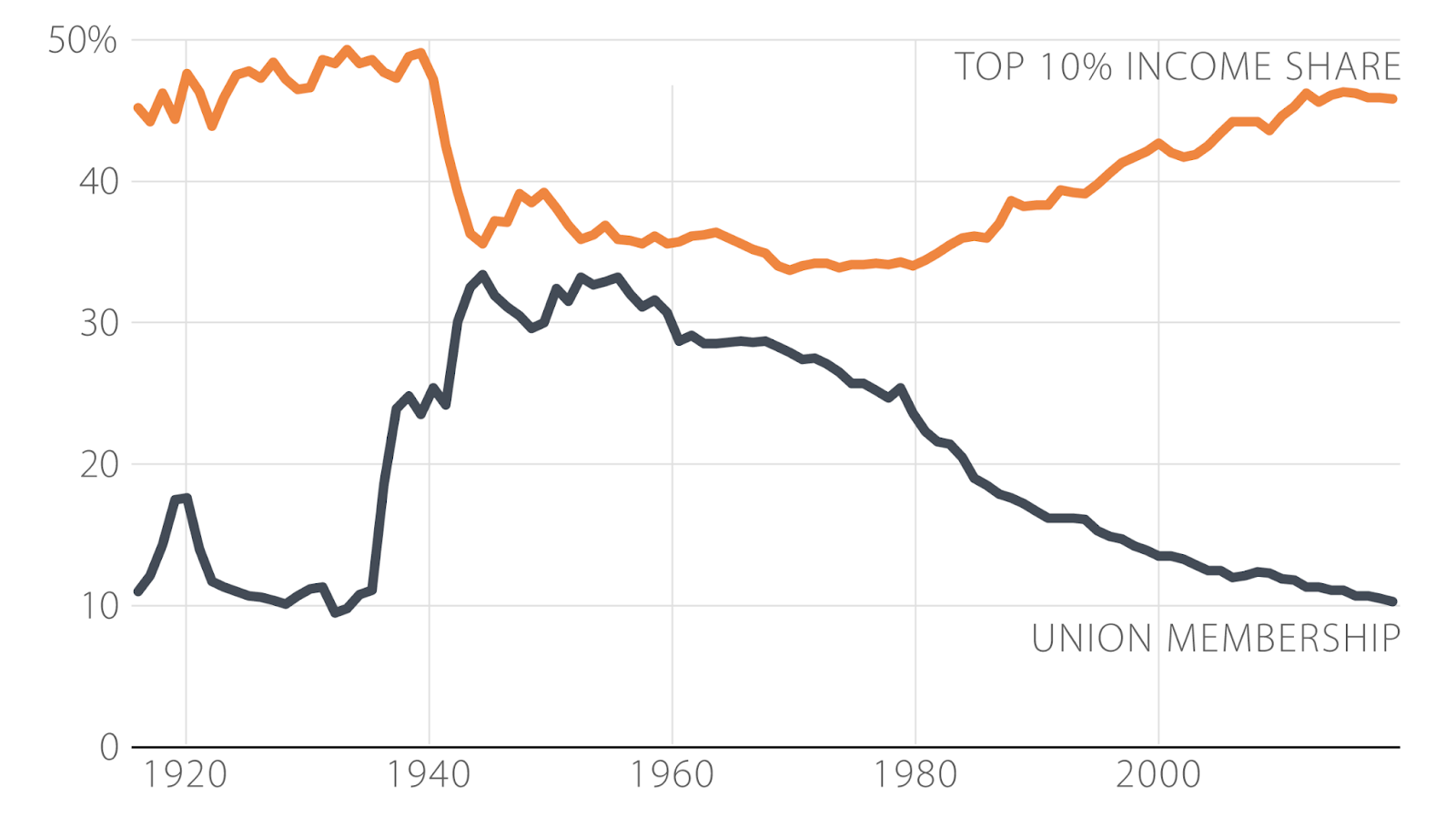 Citation: https://www.epi.org/publication/labor-day-2019-collective-bargaining/ |
The International Union, United Automobile, Aerospace and Agricultural Implement Workers of America, or more commonly known as the United Auto Workers, (UAW) formed in Detroit, Michigan in 1935. Over the next 35 years, UAW increased its membership and its notoriety through infamous sit-down strikes against General Motors, Chrysler, and the Ford Motor Company. UAW has a history of strikes and high-profile failed attempts at unionization. It all adds up to a significant loss of membership and power. | The first paragraph is correct! UAW is 90 years old this year. Workers in Flint, MIdecided to organize a sit-down strike in the 1930s because they had no say over their working conditions and management refused to acknowledge their concerns. After a series of escalating actions, they ultimately voted to go on strike to form a union. Afterwards, more and more workers began forming unions when they saw that their unionized peers were able to negotiate better pay, benefits, and working conditions. As union membership increased, so did economic equality (see graph above). In the last 25 years, scientists, researchers, and professional staff have increasingly formed unions. We join 125,000 research and academic workers who have organized with UAW. We decided to partner with UAW because of their successful record helping researchers win strong contracts, including at Lawrence Berkeley National Lab and the National Institutes of Health. In UAW, workers must authorize the Bargaining Committee to call a strike through a Strike Authorization Vote, and 2/3rds must vote “yes” for a strike to be called. While striking is a powerful tool for workers to achieve our objectives, it will ultimately be our democratic decision whether we want to go on strike. |
UAW is trying to increase its membership through organizing campaigns. | We - JPL workers - reached out to UAW in Spring 2024 because of their track record of success winning strong contracts for researchers, scientists, administrators, and other workers at science and higher ed institutions. We want to form a union by, of, and for JPLers. |
The union has filed 403 representation petitions for election with the NLRB in the last 10 years. However, UAW has only won half the time. | Employers spend millions of dollars per year opposing their employees’ right to form unions. Despite those challenges, workers at peer institutions have succeeded: at the University of California, Research and Public Service Professionals won with 83% in favor of unionizing; at Caltech, graduate workers and postdocs won their union with a 76% and 83% respectively vote in favor of unionizing; and at USC, postdocs won with 93%. |
Since 2015, 2,395 unfair labor practices (ULPs) have been filed against UAW for everything from “coercive actions,” to “duty of fair representation” and even “coercion, including statements and violence.” | It's not clear what to make of this citation, since filing charges doesn't clearly correlate to outcomes. And one of the many good things about forming a union is that there are multiple avenues for raising and addressing complaints. The statistic about the number of charges likely comes from Morgan Lewis, the law firm JPL management hired to support their efforts to avoid our union, and who is representing Space X and other corporations in their efforts to undermine the National Labor Relations Board. For what it's worth, Morgan Lewis attorneys appear to charge as much as $1,950 per hour, which begs the question of why management is spending so much money to track down obscure data and build a website to try and stop us from unionizing. |
UAW's rules and regulations govern and control the activities of the employees it represents (including those covered by UAW-affiliate unions, such as those representing Caltech graduate students and trying to represent JPLers) both on and off the job. The union defines that control in writing, in very critical documents – the union constitution and its by-laws. | As we've noted in several places on this Q&A, the Constitution and Bylaws of the UAW are democratically written and approved documents for UAW members to build power and ensure that decision-making is accountable and responsive to members' needs. Many of us who belong to professional associations or other organizations have experience with these types of policies. We're not clear about what kind of "off the job" activities JPL management believes are "controlled" by the UAW Constitution, but we are aware that JPL employment policies govern and control the activities of employees on and off the job without any democratic approval or accountability process available to JPLers. |
“Exclusive Representation” “The International Union and the Local Union to which the member belongs shall be their exclusive representative for the purpose of collective bargaining in respect to rates of pay, wages, hours of employment or other conditions of employment; and for the negotiation and execution of contracts with employers covering all such matters, including contracts requiring membership or the continuance of membership in the Union as a condition of employment or continued employment; and contracts requiring the employer to deduct, collect, or assist in collecting from their wages any dues, initiation fees, reinstatement fees, payable to the International Union or their Local Union.” — Article 6, Section 15 | “Exclusive representation” means that all JPLers benefit from and are protected by the contract should we vote to ratify it. Collective bargaining is a democratic process. One can see the commitment to these principles at FFRDC unions like LBNL (see Articles 6 and 9 of their bylaws for an example). At JPL, this process will include electing a bargaining team made up of JPL employees, collecting feedback through surveys, townhalls, and more, drafting and voting on initial bargaining demands, exchanging proposals with JPL at the bargaining table, and eventually voting on whether or not to ratify any proposed agreement before it goes into effect. Right now, we are all covered by policies created unilaterally by upper management. JPLers currently have no representation and major decisions that impact our lives are ultimately made without our input. |
“Play by the Rules” There are several pages dedicated to explaining what happens to union members who break any of the union rules, including being charged, tried and possibly suspended. The union spells out the ‘Trials of Members’ process of members who violate their constitution, including members who try to get rid of the union. | One of the many reasons we want to affiliate with an established union (UAW) is because of its decades of experience in worker-led decision making. This also includes internal processes, which (like all democratic spaces) anticipate disagreement and the possibility of bad actions. For example if members or officers were to engage in acts of discrimination or fraud or the like, we want robust time-tested processes for ensuring that such people can be held accountable. |
“Whenever it is charged that a member is affirmatively engaged in the promotion, implementation, furtherance or support of any other union or collective bargaining group with the purpose or intent of supplanting the International Union, or any subordinate body thereof, as the recognized collective bargaining agent, or if the member is affirmatively engaged in efforts to decertify the International Union or any subordinate body thereof as the recognized collective bargaining agent… The member shall be subject to suspension or expulsion by the International Executive Board after hearing on such charges…” — Article 31, Section 24 | As we noted elsewhere, these processes enabled UAW members to purge officers who had embezzled union dues in recent years. Management continually avoids saying this, but it bears repeating: all of the "union rules" - from the collective bargaining agreement to the bylaws and constitution of the local and international union are determined democratically. This means that if we find any "rules" objectionable we can change them. We have a voice and vote at the union's Convention (held every four years) to change the Constitution. We would draft and democratically adopt bylaws for our Local union, and UAW members also directly elect their officers - Local Union leadership, Regional Directors, and International Executive Board members - to create additional accountability. And while there are similar "rules" determined by management about conduct at JPL, none of them are created or enforced democratically. As for the language in the UAW Constitution: yes it is true that if we organize with UAW and then some day decide we want to get out of the union, we could lose our membership. Though, we're not aware of any workers who have wished to remove UAW as their representative but maintain their UAW membership. |